Mateusz Demski
[A bucket with water creatures, with a boy, a river, and a tree in the background.]
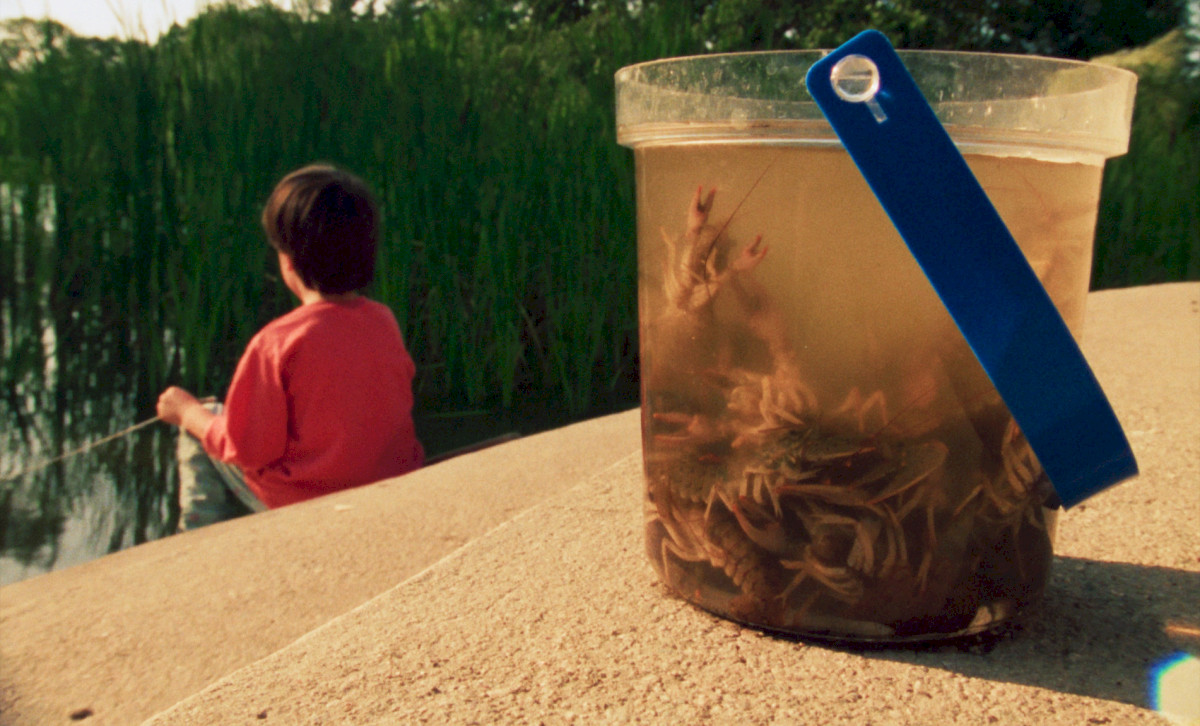
Still from a movie "Bugboy", dir. Lucas Paleocrassas
Waking up at the crack of dawn, the film won’t make itself. So what that it’s only halfway through the holidays, that there’s a break from school and another month of doing nothing left. The stakes, as always, are high – the viewers want to know whether Sheriff George will once again save humanity.
As many as sixty-seven people are waiting on YouTube for the next “Candidates for Death”. Under the mysterious and somewhat eerie name lies the project and the adventure of a lifetime of the documentarian Maciej Cuske. A long, long time ago he took his son Staś and two of his friends on holiday, and promised that they would make a film together. For seventeen years, for two weeks a year, they have been traveling around Poland with cameras and making up more stories about monsters and zombie invasions. He wanted to infect them with a love of cinema, to share that joy with them. It worked.
At first glance nothing has changed, nothing has been lost. Every year they shoot another part of the horror, maintain their friendship, playing with cinema. There is chopping wood with an axe, there are sleepless nights by the bonfire and living in a camper. And yet over time new life matters grow in strength. “It’s our trip, once a year!” – one of the boys explains to his girlfriend over the phone. Each of the three friends is already an adult, focused on himself and his own development, no wonder they drift in different directions. Who would they like to be in ten years? “I’d like to already be a dad by then and not a very fresh one at that,” says Adi, the same one who until recently ran around in a rubber monster mask, with a cap gun. It’s nothing special, quite the opposite. Cuske himself learned at their age that he would become a father.
What is it like when children themselves become adults? It is certainly a breakthrough moment, which does not at all mean that the process has ended. A father infecting his son with passion, a son imitating his father is not the end yet. The bond with a child, even if it has already flown the nest, requires polishing, is subjected to constant trials and tests. One of the great themes of “Candidates for Death” is a conversation with a child about what it is like to have a father and to be a father. Now the roles are reversed – the son tries to educate the father, to teach him new things, the father does not know what lessons await him. And the question appears, to which neither one nor the other knows the answer: what will it be like one day to lose a dad?
“We carry our fathers very strongly within us” – Cuske states at one point. These words could be the guiding slogan of the section In the Name of the Father and the Son. What is significant in this year’s selection of films is that the narrative idea for most of them is a journey of a father with his son. To travel means to get to know oneself. On the road one can learn a lot about oneself. They are not always pleasant things.
Hampus Linder, the director of the film “Confessions of a Swedish Man”, decides to look through the offer of camps for men. There are therapeutic-development camps, survival camps, there are recreational and respite ones. Night dances by the bonfire, rites of passage, field tasks – such places are meant to help discover the fullness of the man within oneself. Linder, initially skeptical himself, sensing in them a hub of the manosphere and anti-feminist moods, takes his father to one of such trips, tells him about his own feelings, those hidden deep – about resentment, grievances, above all the need to get closer to him, which had not been there between them before.
If they could turn back time, perhaps they would have said “I love you” to each other earlier. They do it for the first time in a room arranged for the duration of the camp, in front of a hundred other men. Cuske and his son don’t say it to each other either, even when there is no one around. “I won’t tell you that I love you either” – says Staś. For them it is clear: the lack of these words does not result from the fact that it is not so, simply some things do not need to be said. It is neither a requirement nor an obligation. Acting together, a shared passion can connect people more than gestures performed by force. On the other hand, you won’t get burned by a kind word, it doesn’t hurt at all.
The editors of Fathers, who commissioned me to write this text, did not know that I would be doing it a few days before the birth of my son – in a moment I will become a father myself. None of the films that I saw at the festival will help me with this; I don’t really know what it will be like, I cannot predict anything. I devote time to them, however, to draw conclusions, to take a look at different practices and difficulties. They show me that the experience of fatherhood can vary, they cannot be compared, apart from a general sense of what is most valuable. I don’t like thinking in big concepts, but I will try: anxiety, care, emotional availability, attentiveness, respect, one must also constantly and constantly revise paternal habits. And also adventure – before a camp for “real” men, maybe simply a wild camping trip.
Mateusz Demski – journalist, film critic, film scholar. He publishes, among others, in Przekrój, Przegląd, as well as on the websites Dwutygodnik, GQ Poland, Mint Magazine and Onet.pl. In addition, he contributes as a guest writer to the pages of Gazeta Wyborcza, Tygodnik Powszechny and many other titles. Author of several hundred conversations and interviews with filmmakers awarded at international festivals, including Jonathan Glazer (“The Zone of Interest”), Laura Poitras (“All the Beauty and the Bloodshed”), Bong Joon-ho (“Parasite”), the Daniels duo (“Everything Everywhere All at Once”) and Ari Aster (“Beau Is Afraid”).