Maciej Roch Satora
[A woman wearing a white dress and hat stands on a cliff, with the sea visible in the distance. A burlap sack sits beside her.]
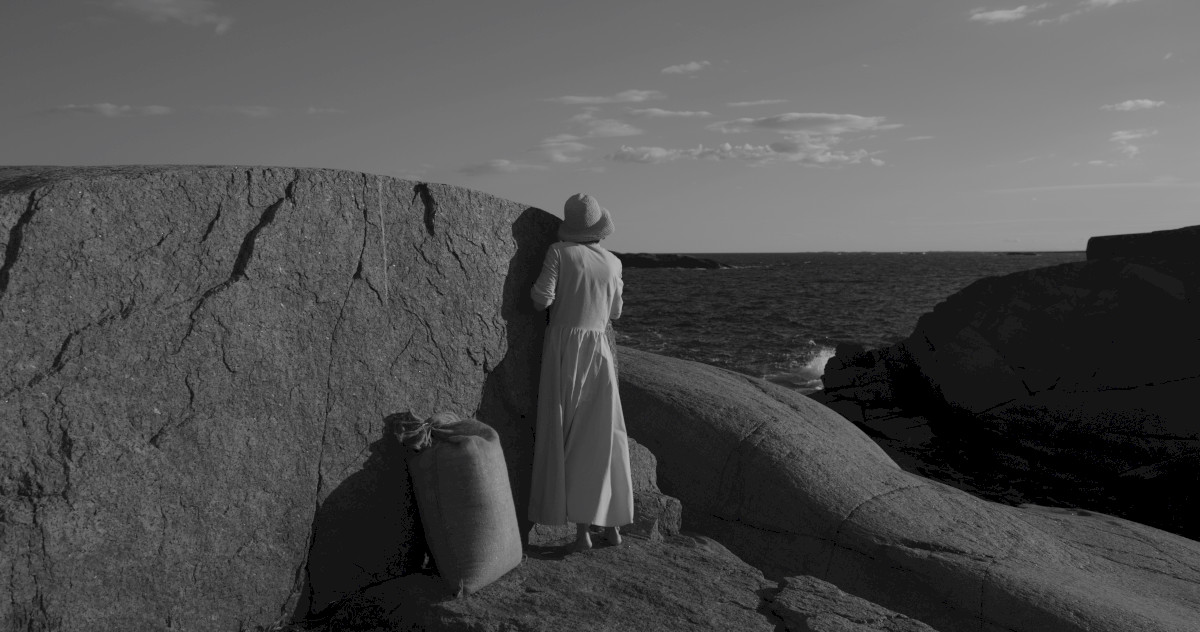
Still from a movie "Trillion", dir. Victor Kossakovsky
Who are the contemporary masters of documentary cinema? Environmentally: filmmakers in their seventies, who over years of artistic exploration have managed to develop their own distinct, authorial language. Globally: authorities directing the world’s attention to important, yet overlooked in the mainstream, subjects. Privately: people of undiminished curiosity, for whom the camera has become the most intuitive means of expression.
Yet this is where the similarities between them end; the tight weave unravels in all directions, the threads reaching the limits of the medium and the peripheries of the documentary formula. Perhaps only in this world can a personal film form become such a sharp mark of recognition. Something that stands out from the crowd no worse than a strong German accent or horn-rimmed glasses. Take someone like Raoul Peck – large letters on black title cards create chapters of a film essay in which archival materials are harnessed to comment on the social here-and-now. You would probably recognize his film from a kilometer away just from a still frame, but that hardly matters. The creator of “Orwell: 2 + 2 = 5” is, after all, an engaged publicist in the world of documentary; the subjects change, but the pen remains the same. This time he dances on film stock to juxtapose the anxieties of the last years of George Orwell’s life with his own fear for the condition of the contemporary world. The writer’s words are illustrated with shots of present and past conflicts; warnings against totalitarianism are met with smiles from Xi Jinping, Vladimir Putin, or Donald Trump.
If we are indeed on the eve of the year “1984” Peck argues that New Year’s Eve may still become an opportunity for engaged resistance, for finding a form of social organization. Perhaps one like in progressive Taiwan, where the radical democratization of the island has become the best tool of defense against the specter of Chinese aggression. Monika Treut, however, prefers to study community on a micro scale, listening to the stories of local activists and representatives of sexual minorities. Her titular “Cooking up Democracy” is precisely an attentiveness to their voices, a focus on shared spaces and a respectful curiosity toward those who are different. She seems to encounter everyday manifestations of openness in the least polarized country in the world almost by chance, guided by years of experience in following another’s gaze, trusting that perspective. A similar tactic is adopted by Ruth Beckermann, for whom the Hilton Addis Ababa hotel becomes an arena of Ethiopian paradoxes. Half the rooms overlook a paradise garden; the other half – corrugated metal barracks, separated from the visitors by barbed wire. It was no different already in the 1960s, when the resort was built for Emperor Haile Selassie. His figure (and attitudes toward him) becomes the core of a story about the identity of contemporary Ethiopia, yet in “Wax & Gold” the director avoids the traps of similarly constructed narratives. As a white European, she opts for a polyphony of voices rather than categorical judgments, knowing that only in this way can she do justice to the history of an African country.
From the east of the continent to the west, we are taken by Werner Herzog, once again documenting what seems to interest him the most: human obsession and unwavering motivation. From behind Dr. Steve Boyes’s shoulder, he follows a decade-long search for giant ghost elephants, which supposedly inhabit the Angolan jungle. These semi-legendary creatures were said to have fled deep into the wilderness out of fear of the destructive actions of humans. That is why in “Ghost Elephants” the loudest question resounds: would it not be better to simply let them live in peace? A similarly pro-animal tone is adopted by Victor Kossakovsky, although “statement” may not be the most adequate word. His silent “Trillion” is a project at the intersection of documentary and performance, in which the camera follows a woman crossing seaside cliffs barefoot. Her scattering of fish scales into the sea is at once a gesture of apology, an exhumation, and a promise of new life – it resembles sowing, as the director’s saturated, black-and-white images transform them at times into droplets, at times into small fish, clinging to the ocean’s depths.
Images are also key for Alan Berliner: specifically, 7,076 photographs cut from the pages of the American daily “The New York Times.” The documentarian collected them for over 40 years to later assemble them into the form of “Letter To The Editor” – a wistful essay about his own relationship with the disappearing press, playing with the aesthetics of collage, found footage, and cartoon. The elegy for print media here just as often enters the territory of broader reflection and personal contemplation, because the story of many can be written through the experience of one. Peter Mettler would likely sign his name under these words as well. The seven-hour “While the Green Grass Grows: A Diary in Seven Parts” overwhelms with its length, but soothes with the diary-like formula of notes from his own life. Such a duration is necessary for him to capture the process in which the experience of bidding farewell to his parents gradually pushes thoughts in new directions, creates unexpected connections with nature; teaches how to live. What a privilege it is to be able to observe this journey.
Maciej Roch Satora – journalist and film critic, editor at the Filmweb.pl portal. He has published in the magazine Kino, the quarterly Ekrany, as well as in the online pages of Dwutygodnik and Czas Kultury.